

Introduction
Today, every other person who uses digital storage is left to ruminate on the issue of online privacy. A limited number of users have had a really nice experience with the apps; others complain about image leaks, unauthorized access, and fragile security systems.
The emergence of an anonymous image vault suggests that individuals increasingly prefer greater privacy and control over their personal files. It is a very good guide for students, professionals, and content creators who need safe storage. This is a read-more on security, encryption, and access protection methods to actively keep your images private and fully under your control.
What is an anon vault in private cloud storage systems?
The anon vault is based on secure digital storage, where people store their files in a protected environment in “private cloud” systems. It functions as a concealed vault for personal images and data, safeguarded against unauthorized access. It is primarily used by students, professionals, and content creators who want maximum control over privacy. Data you share online can get into the wrong hands. The concept is simple: you will use an encrypted cloud space that only the owner can access and view his/her personal data securely.
- Designed for privacy-conscious users and professionals
- The sensor protects sensitive images and personal data
- Utilizes official cloud storage systems with the highest level of protection
Anonymous cloud storage vs traditional secure cloud storage
In short, anonymous and secure cloud storage is mostly a matter of privacy controls and data visibility. Users can save files in anonymous systems, and they often do not link data to user accounts (e.g., Facebook). Secure cloud storage is also more focused on protection, but as a result, it links the user account to the data. Traditional systems are easier to manage, while anonymous storage can better preserve privacy. Both seek to secure data, but differ in the level of control and identity exposure. The comparison helps users determine which system to use, based on their overall privacy and security needs.
Zero-knowledge architecture in modern anon image vault systems
Zero-knowledge architecture. Modern private storage uses it. Think of an image vault. Service providers can’t see your data. You keep full privacy. You stay in control. Sensitive files are very secure.
- No data visibility: The system cannot access user files
- User-only access: Only the owner can open and manage data
- Encryption-based design: All files are locked using strong encryption methods
End-to-end encryption and encrypted cloud storage protection
Within these anonymous image vault platforms, a mechanism known as end-to-end encryption enables a high level of data protection. It makes sure that files are locked before exiting the device and maintains their defenses until they reach storage. Even during transfer, a third party can’t see or read any data. Now, encrypted cloud storage takes that one step further, where your files remain encrypted in their entirety, even while inside the secure pocket of the cloud environment. This method of protection prevents data leaks and protects history by using an accessible system with reliable memory recording and protected storage from point A to B, preventing unauthorized access.
Anonymous file storage and cloud storage privacy control
Together, anonymous file storage and cloud storage privacy help you maintain full control of your digital identity and ensure the safety of the data inside the anonymous image vault. To enable the possibility of storing files while respecting high privacy settings and without revealing which method is used for this. Thus, the system seems to offer a suitable solution for users who need secure, hidden storage.
- Identity hiding: User details remain undisclosed during storage
- Secure access layers: Multiple protection levels prevent unauthorized entry
- Privacy settings control: Users manage who can access or view files
Secure file sharing inside the Anon Vault systems
Above, anonymous image vault systems, due to their secure file-sharing feature, send any kind of file securely without revealing identities or causing data leaks. It encrypts shared files so that they can only be accessed by individuals you choose. This ensures pictures and documents stay personal when traded throughout platforms. This lowers the risks of interception, unlawful downloads, or being followed. Their users can share necessary data without compromising confidentiality, having full control over when & how the files should be accessed.
How Anon Image Vault handles security and data protection
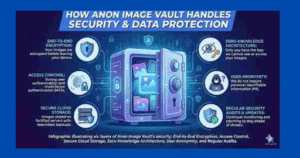
To ensure your data is secure, the Anon Image Vault system uses multiple layers of security to protect your information from abuse by hackers and malicious apps. Your files get strong privacy. Storage is secure. You control who sees each upload. Security-focused web users like this.
- Access control: Only verified users can open stored files
- Encryption layers: Data is protected using multiple encryption methods
- Data safety rules: Strict system rules prevent leaks and unauthorized sharing
Conclusion
People care about digital privacy. Especially when storing files online. An anonymous image vault offers solid protection. It stores things securely. Controls who sees them. Keeps your images safe. No leaks, no tracking. Strangers can’t see them. You control your data. Advanced privacy tools do this. Encryption helps. Cloud storage gets better. More reliable, more private. Safer for daily use. No need to worry about security. Or data getting out.
Frequently Asked Questions
Anon image vault. What does it do?
Stores private pictures. Keeps personal files safe.
Safe for private photos?
Yes. Encryption. Privacy controls protect them.
Can anyone get into the Anon vault files?
No. Only authorized people see the data.
How does the Anon Vault hold data?
Encrypted cloud storage. That’s how it stores stuff.
Cloud storage. Better for privacy?
Yes. If encryption is strong. If controls are there.
Delete a file from a vault app. Can you get it back?
Some apps let you. Depends on backup settings.
Vault apps. Do they encrypt?
Most do. Advanced encryption keeps things safe.
Anonymous storage. Legal?
Yes. Legal for personal privacy
