


Introduction
Cloud technology is changing the way organizations operate and manage data these days. Various businesses still have a long way to go in terms of complexity and poor systems, while they are going through the so-called process of digital transformation. This guide helps to rationally narrow that change. All readers who are searching for cloud computing for their business will have a good understanding of modern solutions.
In this article. A book such as this, the cloud computing guide, explains the nature of these systems with a simple and structured approach at all times. This is the Cloud Computing Guide 2026 for all business owners, IT teams & beginners who are confused by modern cloud tools. A cloud computing system is a business environment that can store, manage, and expand the amount of its data most efficiently.
Cloud Computing for Businesses in 2026: Advantages, Drawbacks, and Future Development
By 2026, companies can be expected to find their operating models undergoing tremendous changes. It’s driven by faster movement to the cloud. This is why today many organizations have started adopting business cloud solutions to increase speed and efficiency across systems. Increasing interest in cloud computing trends 2026 indicates the direction of businesses toward a more and more scalable digital infrastructure.
In this contradiction-driven. An Introduction to Binary, in simplified ioncloud.netud net) Modern cloud strategies and future direction explained. Companies are weighing risk and opportunity by stabilising systems for increased performance, security, and future growth. Cloud technology today enables smarter planning and faster execution of a business expansion.
driven.io Cloud Computing Guide: Everything You Need to Know in 2026
Cloud systems can be very complicated; therefore, modern businesses require clear guidance. drivenIo Guide Cloud Computing: Refresher Overview: How Companies Store Database Infrastructures and Infrastructure in a Single Location.
It lets users learn real cloud operations without confusion. Platform-level overview: This is to help IT teams and new practitioners make their decision more easily. A large number of organizations use services from service providers to scale up their digital systems and work more efficiently. It also identifies parts of the process that can help you plan and run your cloud environment better.
- Introduction to Cloud Computing for Beginners
- Tools that are more modern-day Cloud environments
- Strategies for Cloud Conversion and Scaling
What Is Cloud Computing?
Cloud computing is a relatively new field that enables businesses to store and manage data over the internet rather than locally driven Guidedriven. Cloud Computing Systems describe how companies use an internet-based structure for enhanced control and efficiency. It supports such digital functions as storage, software access, and remote services.
Thousands of platforms rely on types of cloud computing to centrally coordinate workloads in heterogeneous environments. Utilizing application hosting, businesses can run apps seamlessly over-burdening hardware that ultimately enhances accessibility as well as performance.
Why Cloud Computing Matters in 2026
Thanks to fast digital progression in 2026, cloud technology has become an integral part of businesses no
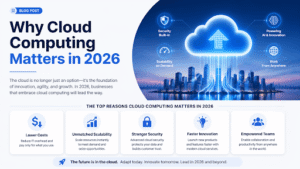
w. Techim.io Cloud Computing Insights: Guiding insights guide; What Should Organizations Use to Understand Why Cloud Adoption Improves? Operations. With companies shifting their focus to automating daily workflows efficiently, quickly, and securely.
Cost has become the mantra of many enterprises to lower infrastructure expenditure and streamline budgeting. Remote collaboration has also become more common, and remote work systems are an indispensable part of modern business operations that enable flexibility through which productivity can continue without interruption across teams.
Key Benefits of Cloud Computing for Businesses
Cloud systems have powerful strengths, particularly for businesses seeking growth in the competitive world today. The drive. This leads to improved speed of the systems, better access to data, and operational control. A great many organizations leverage cloud computing benefits, discovering how to increase overall productivity and efficiency.
- Performance improvement across systems
- Cost savings in IT infrastructure
- Business growth through scalable solutions
The complete idea of scalability and flexibility enables businesses to adjust the resources, which, according to demand, making business operations more reliable.
Types of Cloud Computing Models
Cloud systems are further segregated into different models to help businesses manage their workload driverlessly. The drive. This Guide explains the cloud computing structure of organizations to choose between type models and scalable models as per needs.
The hybrid cloud model, which generalises a mix of private and public systems to achieve greater control, is one such approach that has gained a lot of traction. An example of a modern approach is edge computing; data closer to users results in faster performance and lower efficiency.
Common Business Use Cases of Cloud Computing
Cloud computing still remains popularly adopted by different organizations in order to improve efficiency and effectiveness. The enterprise cloud is widely used by many businesses in order to facilitate complex processes safely and efficiently.
The application of cloud-based platforms enables organizations to process data instantly, which helps to make more effective decisions and provide better services to customers. As a result, businesses have high performance and efficiency rates.
- Data management and storage
- Application hosting for business tools
- Automated reporting systems
Challenges of Cloud Adoption
While the use of benefits to businesses/businesses benefits, it also comes with driving challenges. The Driven. Your guide to cloud adoption insights: Common problems companies face when migrating and using the cloud.
A Computing is a Cloud Computing Challenges Area that focuses on system complexity and integration issues. Cybersecurity in the cloud is yet another important segment wherein companies should try to prevent unauthorized access and cyber threats whilst maintaining stability and trust amongst the systems.
choosing between Google Cloud, AWS, and Azure
Selecting the appropriate cloud service is vital to success. The Cloud Platforms IO Comparison Guide makes it easier for customers to understand the differences between cloud platforms. The AWS vs Azure vs Google Cloud debate is all about their performance and the features of every provider. Data storage solutions: Companies also look into data storage to facilitate secure, scalable, and efficient handling of business data throughout cloud environments.
- AWS for large-scale infrastructure
- Azure for enterprise integration
- Google Cloud for AI-driven solutions
Cloud Computing Trends to Watch in 2026
Cloud technology is changing how companies do business, and it is driving a rapid Future Cloud Trends Guide. The Future Cloud Trends Guide helps organizations to anticipate the innovations and improvements you can make across your systems. For example, the trend of serverless computing enables organizations to run their application without having any servers themselves.
The second kind of software development that we have is AI cloud services, which can significantly increase data processing, decision-making, and automation. What are the most popular cloud computing models?
Conclusion
Cloud computing is a pillar of modern-day expansion and digitalisation. The drive. However, as the Io cloud computing final guide explains, organizations today can achieve greater efficiencies through the adoption of a scalable, secure model. Companies that invest in cloud systems witness higher performance, better data management, and enhanced collaboration.
It also enables long-term stability and innovation in rapidly changing markets. Cloud technology is a wonderful enabler for businesses, certainly keeping them on the cutting-edge of operations and future preparedness in an increasingly digital world.
Common questions
Does a small firm really benefit from cloud computing?
Indeed, it saves money. increases the versatility of small enterprises. aids in their development.
What differs cloud hosting from conventional hosting?
Numerous servers are used in cloud hosting. One system is used in regular hosting.
What is the best decision for choosing AWS, Google Cloud, or Azure?
Based on cost, choose. Examine features. Adapt to the requirements of the business.
What advantages does cloud computing offer to companies?
More scalable. Saves money. Smoother operations.
What obstacles exist for cloud adoption?
Migration is difficult. The issue of security is one of the problems. Those are the typical problems.
What would be the advantages of cloud computing for businesses in relation to scalability?
Resources can fluctuate. Based on demand.
Is the cloud more secure than traditional systems?
In fact, the encryption systems and continuous monitoring are at a high level.
Which are the most widely used cloud computing approaches?
Multi-cloud, Hybrid, Private, and Public. These are the main types of them.
