

introduction
Many people are often bewildered by IQ results. It is often confusing why people are given figures such as 85, 100, or 130, and what they mean in their true form. The ‘IQ test results scale’ clarifies scores by grouping them into simple categories everyone can understand. This section will be beneficial for pupils, parents, and any other reader to fully comprehend the true measure of someone’s intelligence from their results.
This guide is made to remove that confusion and thoroughly explain everything. After reading, you will clearly understand IQ ranges, score meanings, and how tests are interpreted in real life without any complexity.
How to understand IQ scores.
Based on the established scoring system, potential is measured with tests, as in IQ scoring. The IQ test results scale is used to interpret scores relative to other individuals. Without this system,
IQ numbers would have no clear interpretation or reference point. It is widely used in IQ score scales to describe how intelligence levels are distributed among people. This helps make a fair and scientific determination of whether a score indicates average, above-average, or below-average performance.
- Based on a standardized IQ system for fair measurement
- Helps interpret results using IQ score classification levels.
- Supports accurate understanding of cognitive performance differences
What Is an IQ Score Scale?
The IQ test scale is an accepted method of assessing human intelligence using defined, standardized testing procedures. This performance is transformed into an index that reflects that human being’s performance relative to others in their age category.
A scientific system to ensure a fair comparison between each test subject is employed by the IQ test results scale. Contemporary IQ testing predominantly uses a psychometric system and a deviation IQ model to assess an individual’s IQ score.
IQ Score Ranges Explained (With Chart Table)
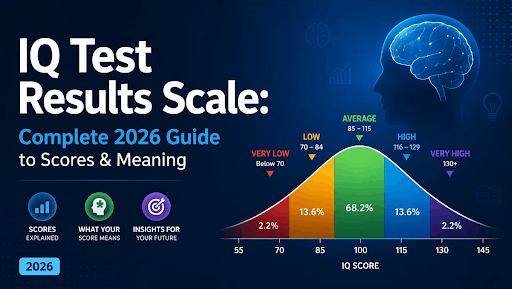
IQ score ranges are divided into clear categories to simplify and structure interpretation. The IQ test results scale is applied to classify individuals based on their performance. With this classification, it is clear how to determine whether an individual’s performance is below average, average, or above average.
The IQ score classification system is adopted, with each score classified into a specific measure. These categories are based on statistical distribution and help identify cognitive strengths and limitations across different intelligence levels.
IQ Score Range Chart
| IQ Score Range | Category | Meaning |
| 130+ | Very High | Gifted-level intelligence |
| 120–129 | High IQ | Strong reasoning ability |
| 110–119 | Above Average | Better than normal intelligence |
| 90–109 | Average | Normal population range |
| 80–89 | Low Average | Slightly below normal |
| 70–79 | Borderline | Learning difficulty range |
| Below 70 | Extremely Low | Cognitive limitation range |
Explanation
This IQ score classification system helps organize intelligence levels into clear and easy-to-understand groups. It allows readers to quickly identify where a score falls on the cognitive scale. Each category shows a different level of mental ability, from average to gifted. This structured format makes IQ results simple, clear, and easy to interpret without confusion.
Average, Good, and High IQ Scores
To assist people in understanding performance variations, IQ scores are categorized into basic levels. The IQ test results scale shows that an average IQ typically falls around 100, which represents the normal population mean.
A good IQ score often falls above average and reflects stronger reasoning skills. Having a high IQ means a person has better problem-solving and learning capacity than the average person. The ranges classify people to indicate their position relative to others without unjust comparisons or misinterpretation of the test.
IQ Classification System Explained
The IQ classification system organizes intelligence scores into structured levels based on statistical patterns. The IQ test results scale uses this system to divide scores into categories like average, high, or low. It is built on an IQ classification system that follows a bell curve distribution,
Meaning most people fall in the middle range. The deviation IQ model ensures fairness by comparing individuals within the same age group. This system makes IQ results easier to interpret and more scientifically reliable.
What IQ Is Considered Genius?

The term “genius IQ” is usually understood to refer to the upper end of the spectrum. As we see on the IQ test results scale, values of 130 and above are. These individuals may qualify for Mensa qualification IQ score levels or advanced academic programs.
However, genius status is not only about numbers but also about how intelligence is applied in real life. Gifted programs also use educational gifted classification to identify exceptional learning ability in students. Scores above 130 are considered very high intelligence
- Linked with Mensa qualification IQ score eligibility
- Genius is not only about numbers, but also real-life application
- Gifted programs use educational gifted classification systems
- Learning ability in students.
IQ Percentiles and Standard Deviation
IQ percentiles also illustrate a person’s standing relative to the rest of the population. In IQ test results, percentiles indicate how many samples scored below the respective score. One example of this is that higher percentile scores indicate stronger performance than the vast majority.
A normal distribution is data with a bell-curve shape, so most scores will be near the average. Standard deviation, which is typically set to 15, indicates the distance of a score from the mean and provides a suitable measure for making impartial comparisons between IQ distributions.
How to Interpret IQ Test Results
Understanding IQ results requires more than just looking at a number. The IQ test results scale explains how scores reflect different cognitive abilities rather than overall worth. A key part of interpreting IQ test scores is the confidence interval.
This indicates that scores can vary slightly due to testing conditions. Subscale scores are important too, e.g., Verbal skills, speed of reasoning, and memory skills. Subscale scores matter a lot. Verbal skills, reasoning speed, and memory skills really give us a clearer picture. They help us dig deeper into someone’s strengths and weaknesses.
Why IQ Scores Differ Across Tests
IQ scores can vary depending on the test used and its structure. The IQ test results scale is not identical across all platforms because different systems use different norms. A major reason is norm sample IQ testing, where results depend on the group used for comparison. A high IQ score shows strong problem-solving and learning skills.
This ability sets someone apart from most people. These categories help folks get a clearer picture of where they stand. They can figure it out without making unfair comparisons or misreading test results. Scores change due to different testing systems
- Based on norm-sample IQ testing, comparison groups
- Test reliability affects the consistency of results
- Design and difficulty levels impact final score accuracy
What IQ Scores Really Measure
An IQ score is intended to be a formalized speculation about limited mental abilities as opposed to your general intelligence in life. The IQ test results scale is based on cognitive skills such as reasoning, memory, and problem-solving. It assesses metrics of verbal comprehension, processing speed, and deductive reasoning.
On the other hand, IQ tests also have their limitations because they evaluate neither creativity nor feelings nor even practical life skills. Though valuable, these scores represent only certain facets of intelligence and cannot be interpreted as an all-inclusive metric of human capability.
Conclusion
IQ scores only make sense when they are understood through a proper system. The IQ test results scale helps organize intelligence levels into clear categories, allowing people to interpret results without confusion. Every score, whether average or genius, shows where someone stands on a structured scale.
It doesn’t mean there’s a definitive judgment on ability. While an IQ is just one facet of the picture of human intelligence. Proper insight into what it entails comes only when the interpretation of the score is combined with the testing situation and the strengths of the individual being tested.
Frequently Asked Questions
What’s a good IQ score?
110 to 119. That’s good.
120 IQ. Is that high?
Yes, it’s high. Above average.
110 IQ. Good?
It’s above average. Shows you reason well.
Does your IQ change with age?
IQ stays stable. Some cognitive abilities can shift.
Average IQ score?
Usually 100 on standard tests.
Improve your IQ score?
You can. Learning helps. Practice helps. Education helps.
What does an IQ score show?
Reasoning. Problem-solving. Memory. Other thinking skills too.
140 IQ. Really high?
Yes. Exceptionally high. Puts you with top performers.
